Buying leather products can be tricky with synthetic alternatives getting more convincing every day. However, real leather has distinct natural traits that faux leather (like PU, PVC, or "vegan leather") simply can't replicate.
Here is a quick breakdown of what to check before you make a purchase:
1. Look Close at the Surface & Grain
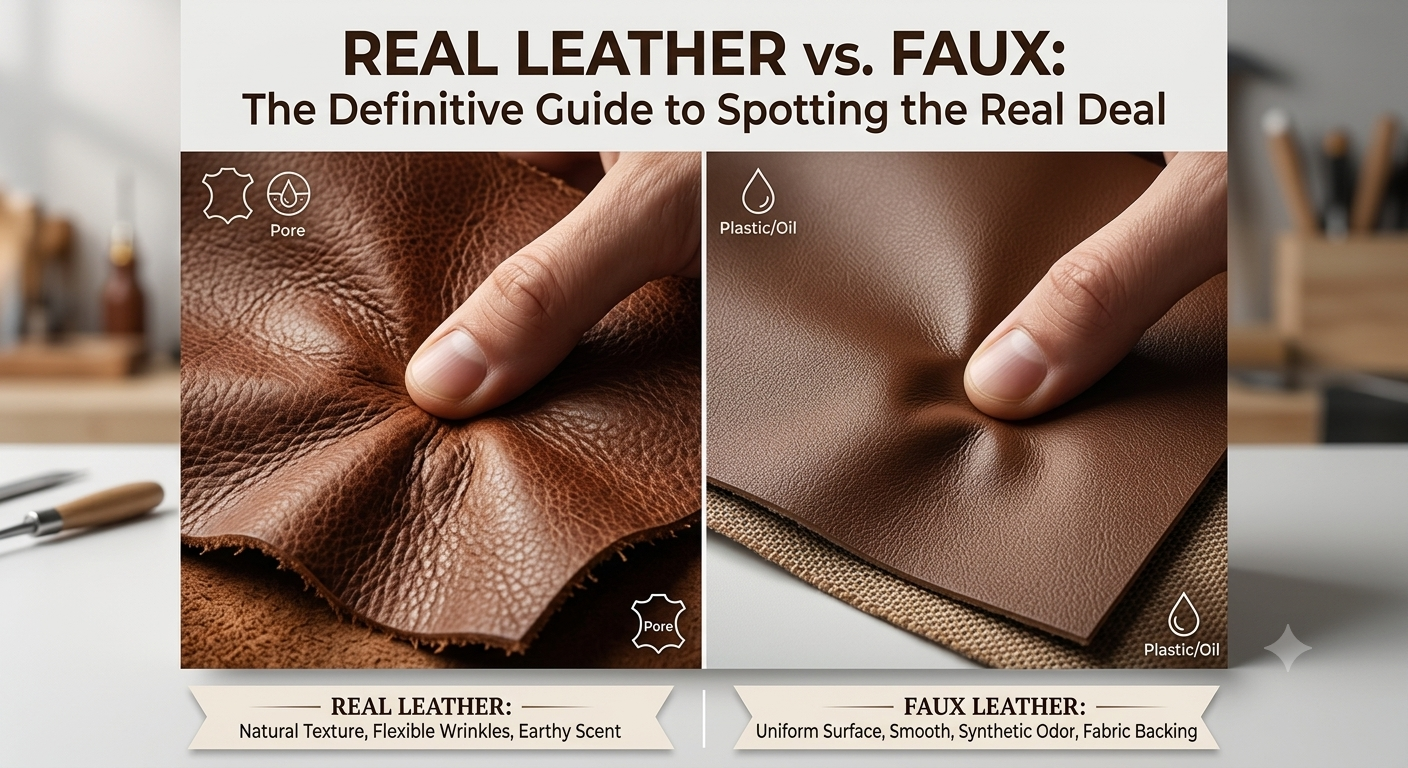
Real Leather: Has unique, natural imperfections, slight pores, and subtle variations in texture. No two areas look perfectly identical.
Fake Leather: Shows a uniform, repetitive grain pattern because it’s machine-stamped. If the texture looks flawless and symmetrical, it's synthetic.
2. Touch and Bend It
Real Leather: Feels warm, soft, and flexible. When you press or bend it, it will wrinkle naturally like real skin and slightly change tone (pull-up effect).
Fake Leather: Feels cool, smooth, or rubbery. When pressed, it resists or depressing like plastic without soft micro-wrinkles.
3. The Smell Test
Real Leather: Has a distinct, rich, organic, and slightly earthy scent that synthetic materials cannot imitate.
Fake Leather: Smells like chemicals, plastic, or petroleum.
4. Check the Edges & Backing
Real Leather: Edges are usually rough, fibrous, and slightly frayed unless heavily sealed.
Fake Leather: Edges are clean, perfectly straight, and often show a woven fabric/mesh backing under the top layer.
5. Read the Label & Price Tag
Labels: Look for terms like Full-Grain, Top-Grain, or Genuine Leather. Terms like "Man-Made," "PU Leather," "Polyurethane," or "Leatherette" mean synthetic.
Price: Authentic high-quality leather requires significant processing and raw material cost; if a full leather jacket or bag seems surprisingly cheap, it's almost certainly fake.
Quick Tip: If you're testing an item in person, the press test (pushing your thumb into the material to look for natural skin-like wrinkles) is usually the fastest and most reliable check on the spot!